Tuesday, December 9, 2008

High Drama: From Women of Allah to Rapture.


In America there are opportunities for women today that create a sense of gender equality among the sexes despite the underlying issue of wage differentiations. The roles that women assume for themselves are no longer prescribed, but they can be subscribed. The women’s movement ratified the idea of gender roles since women have been oppressed by a society that bestowed privilege to men. Now, American society encourages that men and women share privilege in households, in workforces, in politics, etc., toward the goal of eliminating gender discrimination. The homogenous mix of gender privilege seems radical in the face of some non-Western cultures, especially in the Middle East. Shirin Neshat, an Iranian artist who left Iran in 1975 for education in America, channels notions of gender restrictions, which are enforced in Iran since the 1979 Iranian Revolution. Neshat found artistic purpose in exploring how Islamic fundamentalism changed Iranian women by veiling them and exchanging the value of an Iranian women’s movement for martyrdom and silence. She also evokes ideas about sexual friction from an Iranian perspective, where in Islamic fundamentalism even shared spaces between men and women is censured.

The Iranian culture that Shirin Neshat experienced and the transience that changed the culture she knew motivated her to approach the subject of Iranian women living in an Islamic Republic. Although she studied art at the University of California, Berkeley and obtained both undergraduate and graduate degrees, she had not been working as an artist for ten years before she found the inspiration for her acclaimed photographic series and video installations. According to the essay Double Vision by John B. Ravenal, she “abandoned art around the time that she moved to New York in 1983.” (Ravenal 448) The subject was not only something she wanted to explore for herself, as a displaced Iranian woman, but also as a means to try and challenge the Western stereotypes of Middle Eastern women. Neshat carefully assembles the Iranian woman’s play on liberation and rebellion without evoking images of women shedding their hijabs and chadors. She manages to avoid all cliché ideas of protest for a poised and emotional convention that only an Iranian woman artist could manage to do out of utter respect, mystified by her own culture.


In 1993, Women of Allah became Neshat’s first exploration of the post-revolution Iranian woman. Neshat built her Women of Allah series over the next four years with many photographs. She created black and white images that dramatized ideas of women enveloped in Islamic fundamentalism. There is an exotic and beautiful quality to these women, which is complicated by the culture’s suppressive attitude toward sensuality. Hamid Dabashi, an Iranian-American historian and culture critic, wrote an essay titled Bordercrossings: Shirin Neshat’s Body of Evidence in which he describes, “By far the most powerful set of binary oppositions now visually collapsing in Shirin Neshat’s work is sanctity and sensuality.” (Goldberg 37) Some of the most recognizable of these show a woman wearing the traditional Islamic chador focally engaged with the camera toting a gun, as in the photograph Rebellion Silence. With this series, Neshat not only began exploring a new subject, she began using photography for the first time to realize her subject. Although Neshat spent her college years studying painting, she incorporated it into her work by painting text directly onto the enlarged photographs.

“She covered the parts of the photograph that expose parts of her body (which by Islamic law were confined to feet, hands and face) with inscriptions of Farsi poetry written by Iranian women such as Forough Farokhzad and Tahereh Saffarzadeh. The poems range in content from explorations of female desires and fears to militant calls for women’s participation in the Iranian revolution.” (Heartney 232)

The woman that is the central figure in most of her black and white photographs is Neshat herself. By portraying herself in this way, she takes a more personal approach in her manifestation of the post-revolution Iranian woman. This could be a response to her never actually having endured the transitions that resulted from the revolution. Other recognizable photographs include the images of hands and feet decorated with Persian texts as mentioned above. Again, a gun barrel is often incorporated peering out from between the hands and feet, as in her photographs titled Guardians of Revolution and Allegiance with Wakefulness. These photographs are believed to be evoking a call for martyrdom and their titles are indicative of this. The violence associated in her work, with the incorporation of guns and ideas of martyrdom, is often seen as being controversial. The discussed controversies surrounding Neshat’s work include the question of applicable stereotypes and Neshat’s intentions. Dabashi, adds to this discussion having written in his essay:

“The criticism leveled against Shirin Neshat by some Iranians, Muslims, or in general by those who advocate the cause of the “Third World”, is that she takes advantage of and thus reinforces the existing stereotypes of Muslim women and as a result perpetuates that image.” (Goldberg 43)

That image is perhaps one of oppression, victimization, disobedience, exoticism or armed protectors of Islam. Perhaps, it is all of these. It is important to note that not all of her photographs incorporate guns; they seem to be especially absent in several photographs where Neshat is shown with a child. Faith and Bonding are two photographs that show a pair of decorated hands holding the hands of a child. In these photographs, Neshat creates images that can be universally interpreted as mother and child and protector of innocence. Neshat’s Women of Allah is a complex array of photographs with unconfirmed meanings that for a Western audience appeals to its curiosities and challenges its tendency to question and speak-out about the revoke of women’s rights in the Middle East.

Neshat’s first major success arose from her first video installations, including Turbulent (1998) and Rapture (1999). In 1999, Turbulent and Rapture won the International Award of the XLVIII Biennial of Venice, which brought International attention to Neshat’s work. In keeping with her signature-dramatized images, Neshat shot these films for video installation in black and white. Ravenal’s essay Double Vision explains, “Each of these short (ten to thirteen minutes long) black-and-white pieces explores a different facet of fundamentalist Islam’s social segregation of men and women.” As Ravenal mentions, with these video installations Neshat moves away from exploring the existence of the post-revolution woman and begins tapping on the idea of gender roles by exploring the contrast between men and women in post-revolutionary Iran’s public arena. However, because of national acceptance concerns, Neshat was not able to actually use Iran as the background for her films. Instead, she filmed in Istanbul, Turkey, and the Moroccan port town of Essaouira. (Heartney 449)

Turbulent is composed of two videos, which together provide a glimpse of both the male and female perspective on the public performance of song in a theater house. The film is shot from behind the man and woman on two videos, which for the viewer creates a type of voyeur perspective as though one were watching from back stage. Revenal’s account of the video installation describes the two screens facing each other, each with a 1950’s vintage microphone set on the stage. While it has been noted in other reviews that the two screens faced each other, there have been instances, such as its exhibition in November 2006 at the Hunter Art Museum in Chattanooga, Tennessee, where the screens were shown side-by-side. The screens facing each other seems more appropriate for developing a further static construction of the circumstances between the man and the woman. Ravenal further points out, “the experience of being caught between the facing projections suggests that viewers are not only observers but also observed.” The man sings first and his song is an Iranian love song. Ravenal cited: “His impassioned song is a traditional expression of divine love based on a thirteenth-century Sufi poem by Persian mystic Jalal al-Din Rumi.” (Heartney 500) In contrast to the man’s conventional performance amid an all male audience on screen, the woman is shown on the other screen alone in the theater. Instead of singing, it sounds as if she is bellowing, and the tonal quality is like that of an animal’s call for warning. As she projects these sounds, absent of melody, the camera circles around her and gains momentum as her performance strengthens. When she finishes, there is only silence, and the men continue to stare out from the other screen. Neshat’s Turbulent is a stunning and captivating display of gender segregation in the public arena, which is very much on the surface of the Iranian male-female experience.

In Rapture, Neshat develops the issue of gender segregation in a more blatant way in that she uses crowds of men and women in a juxtaposition of settings. As in Turbulent, Neshat uses the same convention of dual screens facing each other with men occupying one screen and women occupying the other. The men are shown in an urban setting, moving through the streets in a pack, eventually congregating in a fortification structure. The women, shown on the opposite screen, appear out in a desert. They move toward the camera. Neshat develops a scenario of interaction between the two videos. The men are performing “activities that mostly suggest rehearsal of tradition or release of aggressive tension” and the women “let out a startling kell, a high pitched ululating sound…” that can be heard by the men on the other screen. Ravenal describes the response:

“The men immediately stop their fighting and look across to the women, who turn away from the camera and begin a journey back across the desert to the sea. Once there, they struggle to launch a wooden boat, and six of them set out upon the waves… A parting view shows the men waving from the ramparts.” (Heartney 451)

The communication between the men and the women is reduced to no more than the women’s kell and the men’s waving. By leaving, the women further remove themselves from the men to embrace nature, while the men are left to the confinement of walls. The idea of gender segregation in Rapture is not simply that the genders would occupy separate spaces, but that they would acknowledge each other in a state of otherness, somewhat desensitized having an opportunity to respond but never really doing so. The viewer is left to the awkward space in between.

(The first two video's shown in the video below are glimpses at Neshat's Turbulent and Rapture. Rapture is shown first, then Turbulent.)


Neshat’s body of work has grown considerably and the artistic dialogues that have been introduced continually expand off of Islamic fundamentalism, gender and personal struggle. Some of these works include, Fervor (2000), Passage (2001), Logic of Birds (2001), Tooba (2002), The Last Word (2003) and Zarin (2005). With Passage, Neshat introduces color to her films making a break from the trademark black and white image that further characterized her subjects providing that eerie dual sensory. Neshat continues to explore the genre of performance art with video and evolves artistically through it. This medium provides a space for more dialogue than that of her signature Women of Allah. Her work has never been shown in Iran or other Islamic countries; because of this, Neshat is not likely a celebrated artist within her native country. Therefore, the subject of the post-revolution Iranian women is not likely a real call for liberation or protest in favor of reformation for the Middle Eastern women’s movement. It is a metaphor. Neshat’s work is a look at the post-revolution from her point of view. The West interprets the high drama of her work and sympathizes with her. She is the West’s credible witness and its emissary.

“Less than twenty years ago it was impossible to imagine a Shirin Neshat. Today, it is impossible to imagine her out of the visual repertoire of our world.” (Goldberg 43)

Works Cited

Goldberg, Roselee, Shirin Neshat, and Giorgio Verzotti. Shirin Neshat. Milan: Charta, 2002.

Heartney, Eleanor, Helaine Posner, Nancy Princenthal, and Sue Scott. After the Revolution: Women Who Transformed Contemporary Art. Fort Worth: Prestel Publishing, 2007.

Ravenal, John, “Shirin Neshat: Double Vision” in Reclaiming Female Agency: Feminist Art History After Postmodernism, edited by Norma Broude and Mary D. Garrard, Berkeley: University of California Press, 2005, pp. 447-458.

Monday, November 3, 2008

Provenance Investigations: Colima Dwarf Ceramic Figures.

Mesoamerican artifacts, especially those that have distinct characteristics, like the dwarf ceramics associated with the Colima culture are susceptible to being forged for mass profit. Not only are the Colima horned dwarf figures attractive, but their believed provenance gives them high value in the antiquities market. Depending on source, the medium from which they are made is known as redware, terracotta, ceramic and earthenware. All of which are easily reproduced, and despite technologies like thermoluminescence, particular clay removed from the area of provenance can be used to create a sculptural piece that will pass such authentication processes. This essay will discuss the historical context of the Colima culture, examine two popular horned dwarf figures and one hunchback dwarf from the culture and discuss how one of the three is slightly varied from the others and a possible forgery.

Little is known about the history of the west Mexican cultures, the Colima, the Jalisco and the Nayarit, but the three regions are synonymous with each other. Colima is the smallest of the three western Mesoamerican regions. All three regions are known for their pottery and sculptural figurines, but perhaps the Colima culture produced the most interesting forms of their kind.

The art of the Colima introduce unusual subjects. There are effigies shaped like hunchbacks, dwarfs and animals, as well as bowls modeled to indicate certain types of fruits and vegetables, especially the tuna fruit. Unlike more linear shaped images representing ancient Mexican warriors and gods, the Colima figures are rounded, plump and smooth. They are burnished and often exhibit a dark red or crimson color. They may now have manganese deposits rendering black speckles all over, which were not deliberately incorporated as pigmentation but instead happened as a result of being buried for a prolonged period of time.

Of Colima’s history, the most known comes from the sixteenth century Spanish conquest invasion of Mexico in which Gonzalo de Sandoval established San Sebastian de Colima. He named it after a native local leader, Coliman. It was from Colima that Spanish control was expanded upward into Jalisco and Nayarit. Later, Francisco Cortez would exploit Colima’s coast. Even during this Spanish conquest and into the colonial era, Colima’s Manzahillo coastal region became an important seaport, which served ship repair. (Coerver 103) With Colima’s seaport attraction, it could be presumed that stolen and looted artifacts from Colima’s ancient culture have been taken and shipped off over the last five hundred years.

Today, the scarcity of ancient Colima artifacts results in big collector payouts for vessels, pottery and sculptural art. A number of fakes have been created in an attempt to nab collector money putting the entire canon of true Colima artifacts at risk. Although, many reputable museums and galleries maintain Colima artifacts in their collections it is believed that the fakes were sold in the market, and they are being shown as ancient Colima pieces despite their lack of precise provenance.

An ancient Colima figure that has noted provenance in its cultural origins are the dwarf figures typically found in shaft burial tombs. The figures are petite, at an upwards of 10 inches. The figures do not depict anatomy, but they are considered to be male figures. They are called dwarfs for the sake of describing them, but it is unknown if they actually revered little people. Although dwarfs with and without horns, including hunchbacks, have been found attributed to the Colima culture, the horned dwarf is most peculiar. The horned dwarf sits with its head contorted in a turned position and above the forehead there is what appears to be a small horn shape, which may be a stylized conch shell. The horn has a carved strap that surrounds the horn in a half eight loop that comes from up around the chin then continues back around the head. This indicates that the horn was not pierced through the skin as many of the other Mesoamerican cultures did to areas of the face and ears. Historians and anthropologists have debated the significance of the horn but without any contextual information there is no explanation entirely conclusive.

Peter Furst, an author and anthropologist of Latin America, called for reconsideration of the horn in 1965. Experts were inclined to believe that the strapped horn was an accessory of a warrior. Furthermore, typically the horned dwarf has his arms raised and his right fist clinched or holding something easily presumed to be a weapon. Instead, Furst believed that the horn indicated that the dwarf was a Shaman, a type of healer and spiritual cleric.
“He based his hypothesis on iconography of the figures often termed as being “‘warlike attitudes,’” and suggested that the ‘“warlike”’ postures are far from being in conflict with traits of shamans, since they are expected to combat supernatural evil and other malevolent shamans to protect the community’s spiritual well-being from its enemies. An added feature to his interpretation was the fact that most of the horned figures face in the left direction-an orientation quite commonly associated with dead, sorcery, and a host of other supernatural dangers. Furst also brought up the important notions that these shamanic figures, placed in tombs, were meant to represent pyschopomps for the deceased; guardians of the dead and their souls.” (Ripinsky-Naxon 45)
Presently, most written dialogue for the horned dwarfs mirror Furst’s explanation citing that the horned dwarfs are shamans instead of warriors.


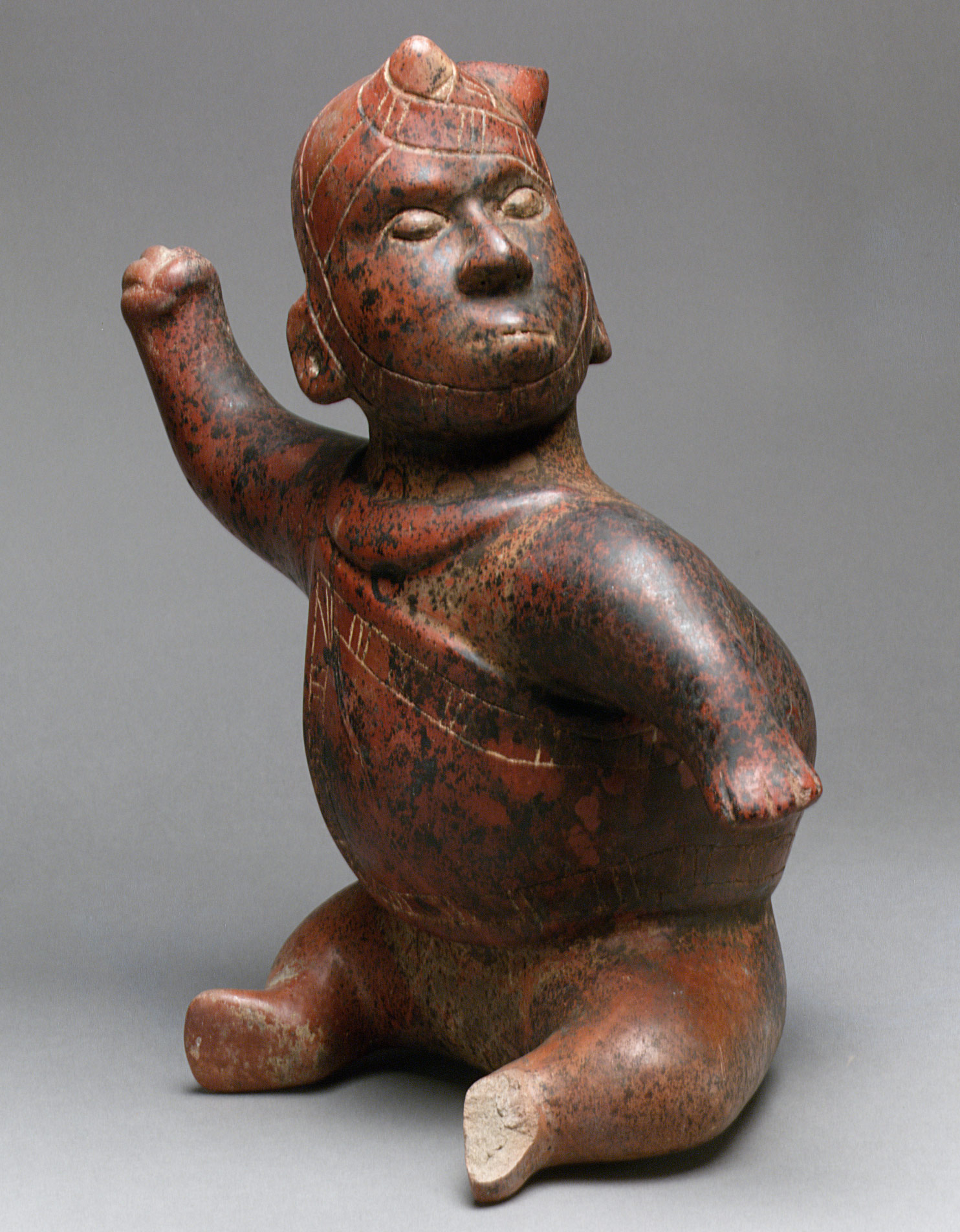
The Metropolitan Museum of Art in New York has a Colima horned dwarf figure, which is a part of The Michael C. Rockefeller Memorial Collection (shown above). This figure is dated between the 2nd century BCE and 2nd century CE. The figure is actually a vessel with a spout opening in the back of the head. It is burnished, appears dark red with lots of manganese deposits covering the torso and face. The seated figure reaches nearly 14 inches in height. Its face is modeled to show naturalistic eye sockets with a brow profile between the lower face and the forehead. Its eyes are almond shaped and constructed outward. The nose, which is more naturally depicted, is also constructed outward from the head. The lips are pressed with no expression. The ears each have holes above the lobe. The upper forehead has the horn and its carved head strap. Its short stubby legs are jutted outward with its feet in a relaxed open position, like an infants posture, if one were sitting up. The figure’s left foot has been partially broken off. The torso of the figure is plump and round, but the weight is not naturally constructed. Instead of the weight being placed with the heaviness slightly downward in a more natural way considering gravity, the figure’s heaviness is conveyed all over the body. The arms and legs are thick and the chest, neck and back are thick and rounded. The torso also has a decorative motif, like a carved mantle, and at the base of the neck there is a modeled collar. As mentioned earlier, this horned dwarf figure has a raised right arm with carved digits indicating the clenched fist. The left arm is down. The head of the figure is contorted facing the left, matching Furst’s assertion that the horned dwarfed figure serves shamanistic purpose. (www.metmuseum.org)

The next Colima dwarf that will be discussed can be accessed HERE. This image is secured and not available for showing outside of its online gallery.

The Colima dwarf figure known as a "hunchback" from the Barakat Gallery in Beverly Hills, California has a form and features that almost exactly resemble the horned dwarf figure from the MET. The figure is dated from 3rd century BCE to 3rd century CE. This figure is just over 11 inches in height. It is not a vessel. While the figure does not sport a horn or carved strap, the seated position, open feet, weight and thickness of the figure are matching. Additionally, the outward almond shaped eyes, nose and pressed mouth is identical. The difference can be noted in the eye socket and brow regions, which are not formed. In place of the horn motif, this hunchback figure has a Mohawk style stretching from the upper forehead to the back of the head. Also, there is a defined line, which extends from ear over the forehead to the other ear as though it were a hairline or a head cap. This figure also has ears with holes above the lobe. The right arm on this figure is raised with its fist clenched holding what could be musical instruments or peyote. The digits of the hand are like those of the MET horned dwarf. The left arm and hand are to the mouth suggesting that the figure is partaking in hallucinogenic ritual. This can be presumed because the figure is also wearing a peyote button on its chest. There is also a decorative mantel carved on the torso of the figure. Though there are a few notable differences between this figure and the MET horned dwarf figure. They are mostly attributed to differences in subject (hunchback v. horned dwarf). The similarities in the overall composition make this piece a believable artifact relative to the Colima culture. (www.barakatgallery.com)


Another horned dwarf figure comes from the Anthropos Gallery in Laguna Beach, California (shown above). The figure is dated from 1st century BCE to 2nd century CE. This is also a vessel with a spout opening in the back of its head. It stands over 14 inches in height making it the largest of the three discussed here. There are a number of differences noteworthy between this figure and the two previous Colima dwarfs discussed. Most of these differences can be described from the head of the figure. The eyes are outward almond shaped but instead of being rounded, they appear to be raised and flat as though they were added on instead of modeled out from the material. While the eye socket’s and brow regions are modeled, they are much more stylized and less naturalistic compared to the MET horned dwarf. The nose is also much bigger. The lips are pressed and curled upward on each side giving a “happy savage” grin. This perhaps is a feature that appeals more to contemporary western ideas about ancient Colima dwarfs instead of their noted lack of expression in typical form. The horn on the upper forehead is bigger and the carved head strap is clumsily carved. The ears are drastically different because they are not modeled out from the material in three-dimension, as are the two previous Colima dwarfs. Instead, the ears are carved on the figure with projectile point-looking decorations coming out from each lobe of the ear. Perhaps, these are the lobes of the figure or a type of decorative ear spool. Either way, they are unknown to Colima dwarf figures. The neck of the figure does not show a distinctive separation between the torso and the head of the figure. The head is not turned in any direction. The hands of this figure are positioned on the legs and not raised or exhibiting clenched fists. While the weight of the figure is similar to the other dwarf figures, the heaviness is most realized in the torso, the shoulder and the upper legs. The weight appears to be concentrated toward the body and becomes slimmer closer to the hands and feet. There isn’t a balance of weight overall as seen in the two previous Colima dwarfs. Because this vessel has the same features but appears to be modeled quite differently in a number of areas, it is possible that this dwarf is a fake. It is possible that a forgery artist took conventions known to the horned dwarf and recreated them in a way that was easy enough to convince a buyer of its provenance while taking for granted its lack of precision. This piece, which is listed as “SOLD”, belonged to a gallery whose sole purpose is to obtain and sell ancient and tribal art. (www.anthroposgallery.com)

The ancient Colima culture is an attractive Mesoamerican culture for creating fraudulent works of art. This is in part attributed to its lacks of contextual history paired with its easily reproduced artifacts. Not much can be argued outside of the formative details. The stories of how artifacts came to be unearthed are just as important to artifacts authenticity as are the consistent physical characteristics. Due to corruption artifacts often have no properly documented excavation and their stories are often obscured.

Works Cited:
Coerver, Don M. Mexico : An Encyclopedia of Contemporary Culture and History. Danbury: ABC-CLIO, Incorporated. 2004. 621.

"Colima Dwarf Shaman." Anthropos Gallery. 28 Oct. 2008 .

"Colima Sculpture of a Seated Hunchback with Peyote Bottons." The Barakat Gallery. 2000. 28 Oct. 2008 .

“Horned Figure Vessel [Mexico, Colima] (1979.206.478)”. In Heilbrunn Timeline of Art History. New York: The Metropolitan Museum of Art. 2000-. http://www.metmuseum.org/toah/ho/05/cam/ho_1979.206.478.htm (October 2008)
Ripinsky-Naxon, Michael. The Nature of Shamanism: Substance and Function of a Religious Metaphor. New York: SUNY P, 1993. 289.

Ahoy Matey! The First People of the Americas Crossed the Sea?

This is an essay that examines the first peopling of the Americas. Though you are likely familiar with the Bering Land Bridge theory, this essay collects recent findings that contrast the idea that they came by foot. If the appropriate artifacts are found art history will help substantiate these claims if/when they come into play:

Scientists have long theorized that the first people native to the Americas moved onto the western landmass via a land bridge which adjoined Siberian and Alaskan coastlines. The theory popularly known as “Bering Land Bridge” faces the challenge of being debunked after recent finds. The discovery of human artifacts in Oregon and other regions predating those found in Clovis, New Mexico (“The Clovis Theory” namesake) cause the theories for historical inhabitation of the Americas to be carefully reconsidered. This process must be mindful in at least three areas of inquiry to support new theorization: are said discoveries made by credible individuals, does the premise for new theorization include logical and factual evidence and how does the new theorization hold up against other long standing theories?

When confronted with the question of how the peopling of the Americas happened, it is important to acknowledge whom these first people were. This information provides a “go-to” point for deciding where they came from in order to consider plausible situations for how and from where they migrated. In 1929, James Ridgley Whiteman discovered remnants of man in the Burnet Cave of the Clovis site, it was the site’s first professional excavation and the oldest known example of human remains in America. Whiteman, led by Edgar Billings Howard, and his team from the Philadelphia Academy of Natural Sciences at University of Pennsylvania proceeded via the academic forum granting them credible expert testimony to evidence of the Clovis people.

Again, the players in these new archeological discoveries, namely those made in Paisley, Oregon since the turn of the century, involve academic and research driven individuals. Senior research associate Dennis Jenkins from the University of Oregon teamed up with other academic professionals from around the world to begin using modern technology to extract DNA information from coprolites (i.e. petrified fecal matter) found at the excavation site, known as the Paisley caves. (Barnard) Jenkins’s research was published in the Science journal as “News of the Week” in April of this year claiming that his is “what some experts consider the strongest evidence yet for an earlier peopling of the Americas.” (Balter) With both professional credibility and an acclaimed publication making Jenkins’s findings newsworthy, it can be assumed that it will not take long for his discovery to spawn further transformations of universal concepts in archeological theory, including how people first migrated to the Americas.

The information concluded from Jenkins’s method includes archeological dating, the peoples’ race and diet. One of the most important conclusions from testing the coprolites is that they predate the Clovis findings by 1,000 years, which make the human remains of Jenkins’s discovery now the oldest known in North America. (Barnard) However, perhaps the most intriguing conclusion involves the race and diet of these people, which indicates where these early people migrated from and the agricultural products and animal proteins provided by their present-day environment. Jenkins gave Eske Willerslev, professor at Center for Ancient Genetics at the University of Copenhagen, some coprolites, which he handed off to a grad student to use in a project for extracting DNA. The grad student, whose name was not provided by the source “found DNA from two of the five Native American genetic groups, both have links to Asia.”(Barnard) In other studies tasking the genetic conundrum, they have similarly linked the possibility that they are related to haplogroups of DNA found in present day Mongolians and Siberians, but studies are on going. (www.pbs.org)

As mentioned, not only do we now have a more precise indication of where these people came from, but we also know what they ate. Given that the radiocarbon evidence from the coprolites suggests that these remains are 14,000 years old, a date that is just 500 years after the presumed end of the last ice-age, it is remarkable that Jenkins found “The coprolites contain pollen, seeds, chipmunk bones, sage grouse feathers, trout scales, things that ancient people would have been eating.”(Barnard) Accordingly, all of this information provides theorists’ new perspectives and new factors to consider when reconstructing the history of the Americas ancient culture.

Not only has the academic community shed new light on the earliest people of the Americas, they have also begun to shed new light on how they migrated. The “Bering Land Bridge” has long been accepted as the most convincing theory for migration to the Americas, but with more recent evidence concerning the geological environment of its time, the concept that people traveled by sea is being examined closely as a real possibility. Ted Goebel, anthropologist and anthropology team leader of Texas A&M, suggests that:
“If this is the time of colonization [13,000 BC or earlier], geological data from Western Canada suggests that humans dispersed along the recently de-glaciated Pacific coastline. The first Americans used boats, and the coastal corridor would have been the likely route of passage, since the interior corridor appears to have remained closed for at least another 1,000 years. Once humans reached the Pacific Northwest, they could have continued their spread southward along the coast to Chile, as well as eastward along the southern margin of the continental ice sheets, possibly following traces of mammoth and mastodon to Wisconsin.” (Boswell)
Goebel says this theory is consistent with the existence of humans in the Americas predating the originally assumed 12,000 to 10,000 BC year bracket. (Boswell) Goebel is not alone in considering this theory, as many publications have surfaced alluding to the possibility of boat migration. Including, a book published in 2000 called The Settlement of the Americas: A New Prehistory by Tom Dillehay, which also mentions the theory of the first migrants coming from Asia to Tierra de Fuego by skin covered boats. Dillehay also explains in his book that the corridor in northwest Canada would have been covered by ice, making this alternative theory conceivable. (Dillehay p.282-283) Although people like Goebel and Dillehay are reputable in their area of expertise and endorse the boat crossing theory, the theory lacks serious evidential support.

While the boat crossing theory seems like the only other logical explanation for how people migrated from Asia to the Americas, the theory has one flaw. Presently, there are no archeological finds suggesting the construction of boats or floating vessels indicating that they sailed across the Bering Strait or any other coastal region or that their boats were skin covered. Canadian scientists have been mindful of the British Columbia coastline to find evidence to support the boat crossing theory. In fact, according to The Vancouver Sun scientists have been watching and waiting for an opportunity to explore exposed sea caves on Vancouver Island and elsewhere in hopes of discovering evidence to substantiate this migration theory. (Boswell) So far, there is nothing to report. So why then argue that the earliest people of the Americas came by boat? Researchers know two things: the earliest people have DNA resembling Asian genetic haplogroups, and they migrated around the time of a warming climate indicating the probability of elevated sea levels. With these two elements considered in this new migration theory, how feasible would it be to have traveled by boat approximately 14,000 years ago?

The Bering Land Bridge theory suggests that either a glacier conjoined the space between the Siberian and Alaskan landmasses between the spaces of the Bering Strait or that the warming trend caused the sea floor to be exposed between the two landmasses after drying up. All things considered, it seems less likely that the sea floor would become exposed with a 98 to 160 foot depth, especially after the melting of an Ice Age that would cause sea levels to rise. The Bering Strait is 53 miles wide from the Siberian to Alaskan coastline, which in the last 100 years has been kayaked, canoed and even skied across. So it should seem at least possible that an ancient people would be able to make the same journey, if they had boats. In fact, Jeff Barnard of the Associated Press made this suggestion in his article “When Did the First People Come to America?”
“The Paisley coprolites indicate people had found another way, perhaps crossing the land bridge but then walking down the coast, or even crossing the ocean by boat, the way people went from New Guinea to Australia thousands of years earlier.”
If an earlier culture from the east is known to have traveled by boat, then it seems likely that another could employ the same method for travel. Theorists acknowledge “strength in numbers.” New Guinea is comprised of 600 islands that are situated 100 miles north of Australia making it 47 miles farther than the journey across the Bering Strait. Additionally, the movement of ocean water would permit a migration from Asia to the Americas. The ocean current moves upward away from the Equator along the Asia coastline and then turns downward along the North American coastline. Therefore, people could have launched their boats from the northeastern part of Asia or Siberia and been guided by the North Pacific current to North America.

The academic and research fields are proving to be persistent, breaking new ground in archeology, anthropology and genetics. With so much information available and becoming available, the boat migration theory could become the next theory to be adopted by primary schools, signifying continual progress in science history. One intricate find could corroborate a new history, but for now, not all of the academic community views these new discoveries with eternal optimism. Barnard wrote this about Vance Haynes, professor emeritus of geoarchaeology at the University of Arizona:
“He would like to see dates further confirmed by another radiocarbon dating because if it is accurate, the find offers important evidence that early people traveled down the coast as they spread through the continent, and then moved east, and did not need the ice-free corridor.”
Only as time and technology move forward will the accuracy of the boat migration theory be revealed.

Works Cited
Alda, Alan, comp. "Coming Into America: Tracing the Genes." Alan Alda: Scientific American Frontiers. Public Broadcast Systems. 28 Sept. 2008 .
Balter, Michael. "DNA From Fossil Feces Breaks Clovis Barrier." 4 Apr. 2008. Science AAAS. 28 Sept. 2008 .
Barnard, Jeff. "When Did People First Come to America." Technology &
Science/Science. 22 Sept. 2008. MSNBC. 23 Sept. 2008 .

Boswell, Randy. "First people came here by boat, researchers say." The
Vancouver Sun. 15 Mar. 2008. Canada.com. 24 Mar. 2008 .

Dillehay, Thomas D. Settlement of the Americas : A New Prehistory. New York: Basic Books, 2001.

Sunday, August 24, 2008

A Response to the film: Sketches of Frank Gehry

Watch the trailer for the film here:


I have seen a number of photographs and video glimpses of Frank Gehry’s architecture since I was a child. There was this period in the nineties that thrived on a style that was bold, not just in shape but also in color, futuristic, and a bit cartoon-like. I think a look at Pee-Wee’s playhouse sort of sums it up, but nevertheless, it had the same kind of animated quality and eye-puzzling slant, as do many Gehry’s earlier structure’s. I remember seeing some of Gehry’s work and thinking “that’s the future.” I took his work for granted, thinking that dozens of different architects were taking their creativity to this new level. Seeing the film Sketches of Frank Gehry resulted in, for me, an surprising discovery.

In the Fall of 2004, I visited the MOMA when it was temporarily being housed in Queens, New York. There, an architecture exhibit was in place, which had models of existing buildings and project buildings. I brought the brochure home, framed it, and hung it up so that my friends could also look at the designs and contemplate which of the projects they would choose. The fifth design on the brochure was no more than an erratic elongated scribble intended for the New York Times headquarters, a project sketch from 2000. No one that visited my home and looked at this sketch really understood it. It was incomprehensible, and it seemed laughable that it held considerable rank among the other more fully realized structures. After watching Sketches of Frank Gehry, I dug the framed brochure out of my closet, and realized the scribble was Gehry’s. The project structure on the brochure never made it to construction, but the film shed new light on the creative vision that is uniquely Gehry’s.

The Sketches of Frank Gehry documentary provides needed insight on how his unique scribbles get off paper and into the real world. The film, directed by the late Sydney Pollack, who confessed that he had little knowledge of architecture, successfully manages the perplexity of Gehry, asking the right questions, encouraging Gehry’s autobiographical dialogue and observing him in his chaotic thinking process, that which is emulated in his characteristic sketch. There’s also the element of celebrity and millionaire endorsement, which explains Gehry’s ability to task the unconventional, and it seems he is sought after for that very reason. What corporate project for a civic building wouldn’t want the draw of being one of Gehry’s infamous structures? The impact of his imagination realized, especially at this magnitude (esp. for the Guggenheim, Bilboa, Spain), lifts the basic platform of functional space design to a level that boasts creativity and purpose.

I’d like to own this film. I think it is somewhat over indulgent because it shows celebrities giving testimony saying they “had to have” one of his housing structures. Other than that, I still feel like his architectural achievement is definitely something to celebrate.

Saturday, August 23, 2008

The Rise of a Chinese Woman: Ch’en Shu (landscape artist)

The great landscape painters of pre-modern China were mostly men. Painting was a desirable skill that was reserved for intellectuals and others who were ranked highly in Chinese society. Women painters of China during this period typically painted floral motifs and garden scenes. Further, many of theses women were courtesans and concubines who had learned the art of painting from their gentleman partners or from other courtesans. According to Flowering in the Shadows, a book devoted to women painters of China, approximately 31,200 entries have been made on behalf of Yu’s biographical dictionary of Chinese historical artists and only 1,046 have been determined to be women (Weidner and Laing 81). One Chinese woman in particular succeeded in being a Chinese landscape and floral painter without resorting to the lifestyle of a courtesan. Like many Chinese women artists Ch’en Shu painted floral genre scenes, but her landscape paintings were among her most desired works. These works included copies of the mastered works of Wang Meng’s, Reading the I-Ching in the Mountain Study and Dwelling in the Summer Mountains. Ch’en Shu was a woman of the gentry class during the 17th century Ch’ing, or otherwise named Qing, dynasty. Ch’en Shu was a traditional woman by means of caring for her family but exceptional in that she was eventually permitted education in reading, record keeping, and poetry writing. Her presence in 16th century Chinese art exemplifies a lifetime of achievement through motherhood and art.

Ch’en Shu’s beginnings were rooted in the good fortune of Ch’en K’rang-po’s military success, her father’s noble acts, and in the mythical presence of the god of literature. Ch’en K’rang-po’s was an ancestor of Ch’en Shu’s who served as an official during the Sung dynasty. He was largely responsible for the invasion of the Chin forces, and he was rewarded handsomely with a mansion in the town of Hsiu-chou during the Hsüan period (1119-1125 CE). The property give to Ch’en K’rang-po became known as the Chekiang province, which is where Ch’en Shu and her family resided in accordance with generations of the Ch’en family (Weidner and Laing 124). Ch’en Shu’s father was not quite as historically significant as his predecessors. Ch’en Yao-hsün was not credited as an artist, nor known to have practiced the skill, but he was an educated man mentioned in the chapter of “Filial and Loyal” in the prefectural gazetteer (Weidner and Laing 125). One deed that led to this honorary title involved the refurbishing of the image of the god of literature and it’s temple, which was near the Chekiang province. The temple was in much need of restoration. Ch’en Yao-hsün responded to the negligence of the temple after dreaming that he was called to do so by the god. Ch’en Shu was born on the same day of the god of literature (the third day of the second month), which was not considered coincidence. Instead, it was believed to be a supernatural event in honor of her father. According to Flowing in the Shadows:
“The recounting of supernatural events is not uncommon in traditional Chinese biographies, but in the case of Ch’en Shu
these tales may have been told, in part, to explain her unusual development to scholarly occupations regarded by some as
unsuitable for women.” (Weidner and Laing 125)
She was noted to have been a “precocious child”, but maintained a quiet demeanor as was expected of a young Chinese girl. She wanted to become educated, but was not permitted to go to school. Instead, she was taught to sew and learn the appropriate skills of a desirable marital partner. In order to compensate for her lack of formal education, she would ask boys in her family to tell her of their readings from school, which she would memorize. Ch’en Shu began copying paintings of the Classics and calligraphy shortly thereafter. She was discouraged from doing this by her mother, who once punished her for perfectly copying a famous painting that hung on the wall of her father’s studio. Her father was fond of her talents and quoted for saying, “It is a pity she’s female. Were she male she would exalt the family name.” (Weidner and Laing 125) Unfortunately, he died before witnessing his daughter’s achievements.

Though Ch’en Shu was eager to become an intellectual and successful painter, she also succeeded in becoming a dutiful wife and homemaker. She married Ch’ien Lun-kuang who was a teacher of general discipline. Like her father, Ch’ien Lun-kuang graduated from the National University and did not pursue further education. He had a reputation for being a calligrapher and poet, which allowed for them to share artistic interest. The Ch’ien family was very pleased with her because she actively sought to help the family prosper. She was very devoted to her mother-in-law, who was persistently ill, and she also settled a debtor who wanted to make a claim against her brother-in-law’s son (Weidner and Laing 126). Ch’ien Lun-kuang left to provide further care for his elder parents, which led to Ch’en Shu assuming responsibility to educate their three sons. They also had a daughter, but in Chinese tradition she was not taught the same curriculum as the boys. She successfully taught their sons. The youngest son, Ch’ien Chieh, earned a living in government as a district magistrate. The middle son, Ch’ien Feng, earned a living as an assistant instructor at the Confucian school. Her only daughter married a gentleman who, like her brother, also became a district magistrate. Her oldest son, Ch’en-ch’ün, became a gradute around the age of fourteen. Ch’en-ch’ün was interested in promoting accounts of his mother’s life and is responsible for spreading the historical accounts of her through his writings. Furthermore, he introduced her paintings to emperor Ch’ien-lung. Later, many of these paintings became part of the Ch’ing imperial collection (Weider and Laing 123). He studied An Ch’i’s collection of paintings and calligraphy. “Perhaps Ch’ien Ch’en-ch’ün presented An Ch’I with paintings by his mother; the late Ch’ing collector Shao Sung-nien owned an album of ten landscapes after the old masters by Ch’en Shu that was marked with An Ch’i’s seals.” (Weidner and Laing 127)
Once Ch’en Shu’s children were grown she was able to invest more time into painting.
The expectations that Ch’en Shu’s own father might have had of her, were she a male, were somehow realized regardless of her gender through imperial designation.

Ch’en Shu was talented in painting a number of subjects, and she preferred painting on the subjects of history and religion. One of the first known works presented to the emperor include an album called Precepts of the Emperors of Successive Dynasties.
“This album, which apparently is no longer extant, was placed in the ‘superior’ category by the cataloguers of the imperial art collection. It opened with images of the lengendary Fu Hsi and Shen Nung, proceeded through emperors of the Chou, Han, and T’ang dynasties and concluded with T’ai-tsu of the Sung period. The figures were described in color on silk, and Ch’ien Ch’en- ch’ün wrote explanatory notes on the facing pages.” (Weidner and Laing 130).

In accordance with her interest in religious attribution she painted Kuan-yin, a bodhisattva. The painting was done as a hanging scroll in ink and light color on paper. It depicts a thickly robed bodhisattva sitting on a flat space that appears to be the edge of a body of water. There is a void of space to the left of the painting, which is not quite as distinguished as the master of voided space, Ma Yuan, and his one corner approach. However, it definitely keeps with the simplicity of Chinese painting figure painting. “The rocks are described with dark, modulated outlines, broad wash, and a few ‘axe-cut’ brush strokes in a manner ultimately based on academic landscape painting of the Southern Sung period…” However, other stylistic approaches to it, such as the “fluid drawing of wavy contours” on Kuan-yin’s robe, are reminiscent of popular artists whom portrayed religious figures in the late-Ming and early Ch’ing. The painting is thought to have been offered to the empress as a birthday gift by Ch’en Shu’s son, Ch’ien Ch’en-ch’ün. Later, the emperor added a poem to the painting and marked it with ten imperial seals, otherwise known as “chop marks”. It reads:
“Shang-yüan ti-tzu Ch’en Shu, imitating the brush methods of Tso-men Sun Shan-jen, respectfually painted the image of
the Universal Door Bodhisattva come forth from the sea. On the third day of the second month of spring in the fifty-
second year of the K’ang-hsi period [1713].” (Weidner and Laing 130)
The poem’s recollection of the “third day of the second month” may be attributed to Ch’en Shu’s birthday, but it is not clearly stated.

The emperor Ch’ien-lung’s enjoyment of art was the result of a period in which he too practiced painting, though calligraphy was a “professional responsibility” as emperor. Therefore, he took to “expressing admiration and pride of ownership” through applying calligraphy that expanded on these ideas directly on the works of art themselves. He began doing this when he was just a prince, which came to annoy the subsequent art critics. (Kahn 135) The emperor also wrote a poem in calligraphy on a painting done by Yüan artist Wang Meng, otherwise known as Wang Shu-ming, which was likely the most influential artist to Ch’en Shu’s style in landscape painting. (Kahn 137) A scroll that she painted in the style of Wang Meng was considered “a work of superior quality” and documented as such in the Ch’ing imperial collection in 1745. (Weidner and Laing 132)
Ch’en Shu’s favoritism for Wang Meng and her reproductions of his works led to her own success as her landscapist.
“Ch’en Shu employed the forms and arrangement invented by Wang Meng, but did not capture all of the grandeur and remoteness of his scenes. In her versions the mountains are smaller in proportion to the foreground trees; the middlegrounds have been compressed to bring the distant mountains closer to the viewer; and the vistas are complicated by the addition of distant peaks.”

There are few surviving works of Ch’en Shu that illustrate her use of technique compared to Wang Meng better than Dwelling in the Mountains on a Summer Day. This painting portrays a rocky mountainous scene with several tree lines and a winding stream edging off the right of the paper. Her imitations of his works may have been done of copies of the works rather than Wang Meng originals. “The lulling abstract patterns of the brushstrokes are better compared to those found in some of the landscapes in old manners by artists of the orthodox school.” (Weidner and Laing 133) Ch’en Shu’s Dwelling in the Mountains on a Summer Day and The Mountains Are Quiet and the Days Grow Long, which are both imitations of Wang Meng’s work, were thought of highly by the emperor. In fact, he wrote on both of them with calligraphy and decorated them with imperial seals.
Ch’en Shu was not always complacent about inscription when it came to her landscape paintings. After all, she studied poetry and married a poet. She once inscribed this on a painting imitating Wang Meng’s Reading the I-ching in a Mountain Study:
“Grasping the brush I wished to imitate Shu-ming’s [Wang Meng] Reading the I-ching in a Mountain Study; but trusting my hand, unexpectedly I incorporated the brush methods of the old master Shih-t’iens [Shen Chou]. Arriving at this peaceful, secluded place, in the hottest days of summer, I am able to forget the heat. Fu-an Ch’en Shu at the age of seventy-five [1734].” (Weidner and Laing 136)

Shen Chou was another source of inspiration for Ch’en Shu as explained in her inscription. He led the Wu School of Suchou during the Ming dynasty. This influence can be remarked about in conjunction with the “dry, choppy strokes define[ing] somewhat awkward tree trunks; blunt round strokes create[ing] contrasting foliage patterns; and repeating straight lines drawn freehand characterize[ing] the simple buildings.” (Weidner and Laing 136) The Suchou style of painting lended to the contributions she made in floral painting.
According to Flowering in the Shadow’s, Ch’en Shu may best be remembered for her flower paintings. Still Ch’en Shu tends to practice painting by copying the works of former artists. In this case, she takes an approach comparable to that of the Wu school artists. She used color without lines when drawing organic figures, like that of Ch’en Shun who was another Suchou master. She based several other works after his, and proudly pressed a seal that stated her intended use of his methods of the paintings included in these albums (Weidner and Laing 143). She shared the same family name as he did, but no relation has been determined. Among her most famous floral paintings includes a pet bird, and the work is titled The White Cockatoo. In this scene, Ch’en Shu depicts a white bird that appears to be chained to an ancient perch, which is either apart of a tree or attached to it. The only indication of this comes from the extending tree limbs full of flowers on both the perch and another limb giving it vertical support in a backward “L” shape. She mentioned in the inscription of this painting that she was using methods used by the ancients, but she did not credit a particular artist as she had in previous inscriptions. It is alleged by Flowering in the Shadows that she may have modeled the cockatoo after the “Snowy-Garbed Maiden”, which was a cockatoo that belonged to a famous Tang dynasty imperial concubine, Tang Kuei-fi. Unique to Ch’en Shu’s other works, this painting is not marked by any other seal other than Ch’en Shu’s artist seal. (Weidner and Laing 143)

Ch’en Shu is an example of an able and talented woman during the Ch’ing dynasty, who in many ways can be regarded as a pioneer of pre-modern womanhood. She faced adversity through the means of seeking to be educated, and attempted to master what only men artists who preceded her had mastered. “She did not stand in the shadow of a male relative or husband…” (Weidner and Laing 147) Furthermore, she progressed in these endeavors after ensuring that her children received a proper upbringing so that they too could become successful in society. Perhaps, she learned a bit more about her potential place in society by teaching them.

All of works that have been mentioned by Ch’en Shu survived through the collapse of the Ch’ing dynasty and have moved from the Imperial Collection to the present day Collection of the National Palace Museum in Taipei, Taiwan, Republic of China. The White Cockatoo is an exception, which is kept at The Metropolitan Museum of Art.

Works cited
Kahn, Harold L.. Monarchy in the Emperor's Eyes: Image and Reality in the Ch'ien-lung
Reign. 1st edition. Cambridge, Massachusetts: Harvard University Press, 1971.
Weidner, Marsha and Ellen Johnston Laing. Flowering in the Shadows. 1st edition. Honolulu: University of Hawaii Press, 1990.