Little is known about the history of the west Mexican cultures, the Colima, the Jalisco and the Nayarit, but the three regions are synonymous with each other. Colima is the smallest of the three western Mesoamerican regions. All three regions are known for their pottery and sculptural figurines, but perhaps the Colima culture produced the most interesting forms of their kind.
The art of the Colima introduce unusual subjects. There are effigies shaped like hunchbacks, dwarfs and animals, as well as bowls modeled to indicate certain types of fruits and vegetables, especially the tuna fruit. Unlike more linear shaped images representing ancient Mexican warriors and gods, the Colima figures are rounded, plump and smooth. They are burnished and often exhibit a dark red or crimson color. They may now have manganese deposits rendering black speckles all over, which were not deliberately incorporated as pigmentation but instead happened as a result of being buried for a prolonged period of time.
Of Colima’s history, the most known comes from the sixteenth century Spanish conquest invasion of Mexico in which Gonzalo de Sandoval established San Sebastian de Colima. He named it after a native local leader, Coliman. It was from Colima that Spanish control was expanded upward into Jalisco and Nayarit. Later, Francisco Cortez would exploit Colima’s coast. Even during this Spanish conquest and into the colonial era, Colima’s Manzahillo coastal region became an important seaport, which served ship repair. (Coerver 103) With Colima’s seaport attraction, it could be presumed that stolen and looted artifacts from Colima’s ancient culture have been taken and shipped off over the last five hundred years.
Today, the scarcity of ancient Colima artifacts results in big collector payouts for vessels, pottery and sculptural art. A number of fakes have been created in an attempt to nab collector money putting the entire canon of true Colima artifacts at risk. Although, many reputable museums and galleries maintain Colima artifacts in their collections it is believed that the fakes were sold in the market, and they are being shown as ancient Colima pieces despite their lack of precise provenance.
An ancient Colima figure that has noted provenance in its cultural origins are the dwarf figures typically found in shaft burial tombs. The figures are petite, at an upwards of 10 inches. The figures do not depict anatomy, but they are considered to be male figures. They are called dwarfs for the sake of describing them, but it is unknown if they actually revered little people. Although dwarfs with and without horns, including hunchbacks, have been found attributed to the Colima culture, the horned dwarf is most peculiar. The horned dwarf sits with its head contorted in a turned position and above the forehead there is what appears to be a small horn shape, which may be a stylized conch shell. The horn has a carved strap that surrounds the horn in a half eight loop that comes from up around the chin then continues back around the head. This indicates that the horn was not pierced through the skin as many of the other Mesoamerican cultures did to areas of the face and ears. Historians and anthropologists have debated the significance of the horn but without any contextual information there is no explanation entirely conclusive.
Peter Furst, an author and anthropologist of Latin America, called for reconsideration of the horn in 1965. Experts were inclined to believe that the strapped horn was an accessory of a warrior. Furthermore, typically the horned dwarf has his arms raised and his right fist clinched or holding something easily presumed to be a weapon. Instead, Furst believed that the horn indicated that the dwarf was a Shaman, a type of healer and spiritual cleric.
“He based his hypothesis on iconography of the figures often termed as being “‘warlike attitudes,’” and suggested that the ‘“warlike”’ postures are far from being in conflict with traits of shamans, since they are expected to combat supernatural evil and other malevolent shamans to protect the community’s spiritual well-being from its enemies. An added feature to his interpretation was the fact that most of the horned figures face in the left direction-an orientation quite commonly associated with dead, sorcery, and a host of other supernatural dangers. Furst also brought up the important notions that these shamanic figures, placed in tombs, were meant to represent pyschopomps for the deceased; guardians of the dead and their souls.” (Ripinsky-Naxon 45)
Presently, most written dialogue for the horned dwarfs mirror Furst’s explanation citing that the horned dwarfs are shamans instead of warriors.
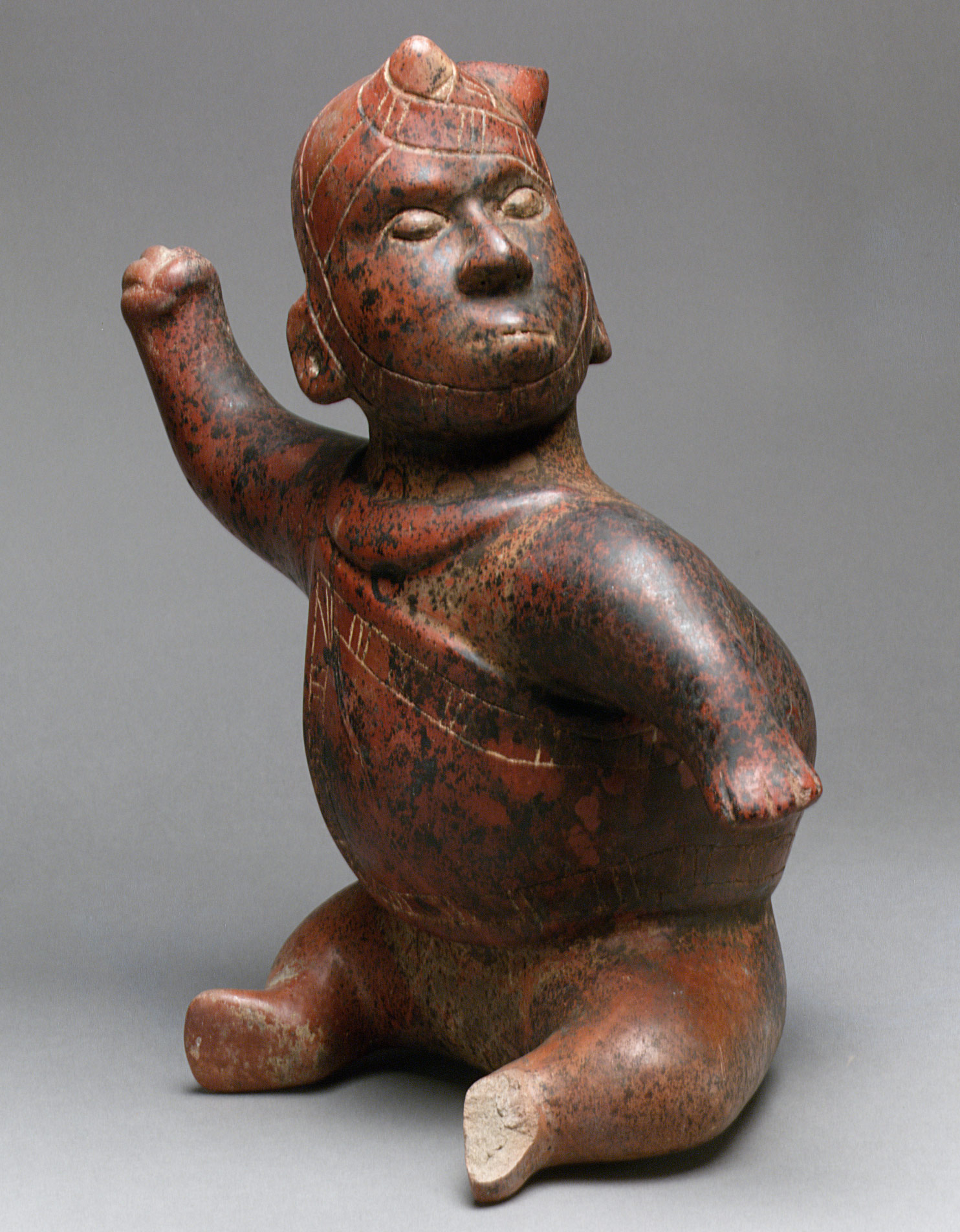
The Metropolitan Museum of Art in New York has a Colima horned dwarf figure, which is a part of The Michael C. Rockefeller Memorial Collection (shown above). This figure is dated between the 2nd century BCE and 2nd century CE. The figure is actually a vessel with a spout opening in the back of the head. It is burnished, appears dark red with lots of manganese deposits covering the torso and face. The seated figure reaches nearly 14 inches in height. Its face is modeled to show naturalistic eye sockets with a brow profile between the lower face and the forehead. Its eyes are almond shaped and constructed outward. The nose, which is more naturally depicted, is also constructed outward from the head. The lips are pressed with no expression. The ears each have holes above the lobe. The upper forehead has the horn and its carved head strap. Its short stubby legs are jutted outward with its feet in a relaxed open position, like an infants posture, if one were sitting up. The figure’s left foot has been partially broken off. The torso of the figure is plump and round, but the weight is not naturally constructed. Instead of the weight being placed with the heaviness slightly downward in a more natural way considering gravity, the figure’s heaviness is conveyed all over the body. The arms and legs are thick and the chest, neck and back are thick and rounded. The torso also has a decorative motif, like a carved mantle, and at the base of the neck there is a modeled collar. As mentioned earlier, this horned dwarf figure has a raised right arm with carved digits indicating the clenched fist. The left arm is down. The head of the figure is contorted facing the left, matching Furst’s assertion that the horned dwarfed figure serves shamanistic purpose. (www.metmuseum.org)
The next Colima dwarf that will be discussed can be accessed HERE. This image is secured and not available for showing outside of its online gallery.
The Colima dwarf figure known as a "hunchback" from the Barakat Gallery in Beverly Hills, California has a form and features that almost exactly resemble the horned dwarf figure from the MET. The figure is dated from 3rd century BCE to 3rd century CE. This figure is just over 11 inches in height. It is not a vessel. While the figure does not sport a horn or carved strap, the seated position, open feet, weight and thickness of the figure are matching. Additionally, the outward almond shaped eyes, nose and pressed mouth is identical. The difference can be noted in the eye socket and brow regions, which are not formed. In place of the horn motif, this hunchback figure has a Mohawk style stretching from the upper forehead to the back of the head. Also, there is a defined line, which extends from ear over the forehead to the other ear as though it were a hairline or a head cap. This figure also has ears with holes above the lobe. The right arm on this figure is raised with its fist clenched holding what could be musical instruments or peyote. The digits of the hand are like those of the MET horned dwarf. The left arm and hand are to the mouth suggesting that the figure is partaking in hallucinogenic ritual. This can be presumed because the figure is also wearing a peyote button on its chest. There is also a decorative mantel carved on the torso of the figure. Though there are a few notable differences between this figure and the MET horned dwarf figure. They are mostly attributed to differences in subject (hunchback v. horned dwarf). The similarities in the overall composition make this piece a believable artifact relative to the Colima culture. (www.barakatgallery.com)

Another horned dwarf figure comes from the Anthropos Gallery in Laguna Beach, California (shown above). The figure is dated from 1st century BCE to 2nd century CE. This is also a vessel with a spout opening in the back of its head. It stands over 14 inches in height making it the largest of the three discussed here. There are a number of differences noteworthy between this figure and the two previous Colima dwarfs discussed. Most of these differences can be described from the head of the figure. The eyes are outward almond shaped but instead of being rounded, they appear to be raised and flat as though they were added on instead of modeled out from the material. While the eye socket’s and brow regions are modeled, they are much more stylized and less naturalistic compared to the MET horned dwarf. The nose is also much bigger. The lips are pressed and curled upward on each side giving a “happy savage” grin. This perhaps is a feature that appeals more to contemporary western ideas about ancient Colima dwarfs instead of their noted lack of expression in typical form. The horn on the upper forehead is bigger and the carved head strap is clumsily carved. The ears are drastically different because they are not modeled out from the material in three-dimension, as are the two previous Colima dwarfs. Instead, the ears are carved on the figure with projectile point-looking decorations coming out from each lobe of the ear. Perhaps, these are the lobes of the figure or a type of decorative ear spool. Either way, they are unknown to Colima dwarf figures. The neck of the figure does not show a distinctive separation between the torso and the head of the figure. The head is not turned in any direction. The hands of this figure are positioned on the legs and not raised or exhibiting clenched fists. While the weight of the figure is similar to the other dwarf figures, the heaviness is most realized in the torso, the shoulder and the upper legs. The weight appears to be concentrated toward the body and becomes slimmer closer to the hands and feet. There isn’t a balance of weight overall as seen in the two previous Colima dwarfs. Because this vessel has the same features but appears to be modeled quite differently in a number of areas, it is possible that this dwarf is a fake. It is possible that a forgery artist took conventions known to the horned dwarf and recreated them in a way that was easy enough to convince a buyer of its provenance while taking for granted its lack of precision. This piece, which is listed as “SOLD”, belonged to a gallery whose sole purpose is to obtain and sell ancient and tribal art. (www.anthroposgallery.com)
The ancient Colima culture is an attractive Mesoamerican culture for creating fraudulent works of art. This is in part attributed to its lacks of contextual history paired with its easily reproduced artifacts. Not much can be argued outside of the formative details. The stories of how artifacts came to be unearthed are just as important to artifacts authenticity as are the consistent physical characteristics. Due to corruption artifacts often have no properly documented excavation and their stories are often obscured.
Works Cited:
Coerver, Don M. Mexico : An Encyclopedia of Contemporary Culture and History. Danbury: ABC-CLIO, Incorporated. 2004. 621.
"Colima Dwarf Shaman." Anthropos Gallery. 28 Oct. 2008
"Colima Sculpture of a Seated Hunchback with Peyote Bottons." The Barakat Gallery. 2000. 28 Oct. 2008
“Horned Figure Vessel [Mexico, Colima] (1979.206.478)”. In Heilbrunn Timeline of Art History. New York: The Metropolitan Museum of Art. 2000-. http://www.metmuseum.org/toah/ho/05/cam/ho_1979.206.478.htm (October 2008)
Ripinsky-Naxon, Michael. The Nature of Shamanism: Substance and Function of a Religious Metaphor. New York: SUNY P, 1993. 289.

